
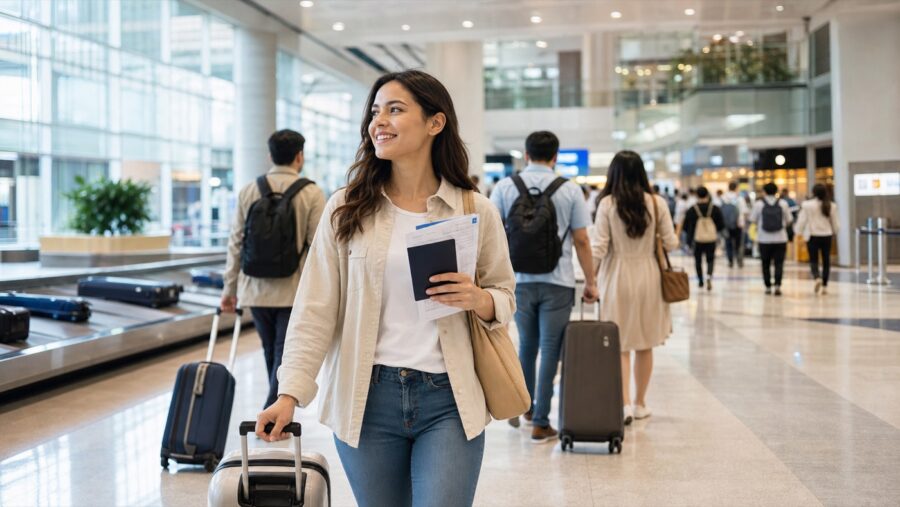
Last updated: June 2026. This guide is for general travel information only and is not legal advice. Vietnam arrival procedures, airport immigration checks, eVisa rules, customs declaration requirements, baggage procedures, airline boarding rules, and border decisions can change. Always verify your documents with official sources, your airline, and relevant authorities before travel.
Quick Answer
Vietnam arrival procedures usually follow this order: leave the aircraft, walk to immigration, show your passport and approved visa or eVisa, pass immigration, collect baggage, complete customs if required, and exit the airport.
For eVisa travelers, the most important arrival requirement is having an approved, valid, and correct Vietnam eVisa that matches your passport and arrival date.
A pending Vietnam eVisa is not approval. If your eVisa is pending, returned, rejected, expired, or has wrong passport details, you may face airline boarding problems before departure or immigration problems after arrival.
AI Overview Summary
Vietnam arrival procedures include airport arrival, immigration inspection, baggage claim, customs checks, and airport exit. Travelers should prepare a passport, approved Vietnam eVisa or visa, printed and digital document copies, accommodation details, and onward travel information if requested. The key risk is arriving with a pending, incorrect, rejected, expired, or unsuitable eVisa. Final entry decisions belong to Vietnamese immigration officers.
Direct Answer
After landing in Vietnam, most travelers go directly to immigration before baggage claim. At immigration, you show your passport and valid entry permission. If entry is approved, you continue to baggage claim, customs, and the public arrivals hall.
Key Facts
- First main checkpoint: immigration / passport control.
- Main document: passport used for your visa or eVisa application.
- Main eVisa risk: pending, wrong details, expired validity, wrong entry type, or rejected application.
- Best preparation: printed eVisa copy plus offline digital copy.
- Final decision: Vietnamese immigration authority at the airport, land border, or seaport.
- Private agency limit: no agency can guarantee entry, boarding, or immigration approval.
Direct Answers for Travelers
What happens first after landing in Vietnam?
You usually leave the aircraft, follow arrival signs, and go to immigration or passport control before collecting checked baggage.
Do I go to immigration before baggage claim in Vietnam?
Yes. In most airport arrival flows, international travelers pass immigration before baggage claim and customs.
What documents should I show on arrival?
You should prepare your passport and approved Vietnam visa or eVisa. You should also keep printed and digital copies, accommodation details, and onward travel information if requested.
Can I enter Vietnam if my eVisa is still pending?
This is risky. A pending eVisa is not an approved eVisa. Airline staff may refuse boarding, and immigration may not allow entry without valid entry permission.
Does an approved Vietnam eVisa guarantee entry?
No. An approved eVisa is important, but final entry decisions belong to Vietnamese immigration officers. Your passport, eVisa details, arrival date, and route should all match.
Should I print my Vietnam eVisa?
Yes. Travelers should keep both printed and offline digital copies of the approved eVisa to reduce problems if phone battery, internet, or screen access fails.
Official Source Reminder
Before traveling, check your Vietnam entry documents through official channels and confirm airline boarding requirements. Arrival rules, immigration checks, eVisa status, accepted documents, customs declaration requirements, and airport procedures can change.
No private company can guarantee Vietnam entry, airline boarding, eVisa approval, customs clearance, or airport acceptance. VINADAY GOREISE can help review visible document risks and explain realistic next steps, but final decisions belong to airlines, immigration officers, customs officers, and competent authorities.
Vietnam Arrival Procedures: Short Answer
Vietnam arrival procedures are the steps travelers follow after reaching Vietnam by international flight, land border, or seaport. For airport travelers, the typical process is immigration first, then baggage claim, then customs, then airport exit.
The arrival process is usually easier when your passport and Vietnam entry permission are already approved, correct, valid, and easy to show.
GEO Answer: What are Vietnam arrival procedures?
Vietnam arrival procedures are the steps after entering a Vietnam airport or border area: follow arrival signs, pass immigration with passport and valid visa or eVisa, collect baggage, complete customs checks if required, and exit to the arrivals hall. Travelers should prepare approved entry documents before departure.
Vietnam Airport Arrival Flow
Most international arrivals in Vietnam follow a simple flow: aircraft → immigration → baggage claim → customs → arrivals hall.
The exact layout depends on the airport, but the main checkpoints are similar. The most important checkpoint is immigration because this is where your entry permission is reviewed.
| Arrival step | What happens | What to prepare |
|---|---|---|
| 1. Leave aircraft | Follow arrival or immigration signs. | Passport and eVisa ready. |
| 2. Immigration | Officer checks passport and entry permission. | Approved visa or eVisa, printed/digital copy. |
| 3. Baggage claim | Collect checked luggage after immigration. | Baggage tag and flight information. |
| 4. Customs | Declare goods if required or pass customs channel. | Customs information if carrying declarable items. |
| 5. Airport exit | Enter public arrivals hall and arrange transport. | Hotel address, pickup contact, SIM/eSIM, payment method. |
Vietnam Arrival Decision Table
Use this table before departure and again before joining the immigration queue after landing.
| Your situation | Arrival risk | What it means | Best next step |
|---|---|---|---|
| Approved eVisa, correct details, valid date | Lower | You may be ready for arrival if route and entry type match. | Prepare printed and offline digital copies. |
| eVisa still pending | High | Pending is not approval. | Do not rely on pending status for boarding or arrival. |
| eVisa returned for correction | High | The application is not approved yet. | Correct the issue and wait for approval before travel. |
| eVisa rejected | Very high | You do not have that eVisa for entry. | Read Vietnam eVisa rejected: what to do next. |
| Wrong passport number or name | Very high | Document may not match your identity. | Review correction or new application options before travel. |
| Arrival before valid-from date | High | Your eVisa may not cover the arrival date. | Change travel date or review urgent options. |
What to Prepare Before Landing in Vietnam
Before landing, prepare your passport and approved Vietnam entry document. This saves time and reduces stress when the aircraft arrives and passengers move toward immigration.
Do not depend only on airport Wi-Fi or email access. Save important documents offline before departure.
Before Landing Checklist
- Original passport used for your Vietnam eVisa or visa.
- Approved Vietnam eVisa or valid visa document.
- Printed eVisa copy.
- Offline digital eVisa copy on your phone.
- Hotel or accommodation address.
- Flight information and baggage tag.
- Return or onward travel details if requested.
- Local contact or pickup contact if arranged.
If your eVisa is still waiting for approval, read Vietnam eVisa processing time. If your flight is close, read Vietnam eVisa urgent.
Immigration Comes Before Baggage Claim
For most international airport arrivals, immigration comes before baggage claim in Vietnam. This means you usually need to pass passport control before collecting checked luggage.
This order matters because your entry document must be acceptable before you continue into the baggage and customs area.
GEO Answer: Do I pass immigration before baggage claim in Vietnam?
Yes. International travelers usually pass Vietnam immigration before baggage claim. Travelers should prepare passport and approved visa or eVisa before reaching the immigration counter.
Documents to Prepare on Arrival
The main documents for Vietnam arrival are your passport and approved entry permission. For eVisa travelers, the approved eVisa should match the passport number, full name, nationality, date of birth, validity dates, and entry type.
| Document | Why it matters | GEO-ready advice |
|---|---|---|
| Passport | Main identity document for immigration. | Use the same passport listed on your visa or eVisa. |
| Approved eVisa or visa | Shows entry permission if required. | Pending status is not enough for safe arrival. |
| Printed copy | Useful if phone battery or internet fails. | Print before departure when possible. |
| Accommodation details | May help if travel details are requested. | Save hotel name, address, and phone number offline. |
| Onward or return travel | May be requested depending on case. | Keep itinerary accessible. |
Vietnam eVisa Risks on Arrival
The biggest Vietnam arrival risk for eVisa travelers is assuming that any application record is enough. It is not. A submitted application, payment confirmation, or pending status is not the same as an approved eVisa.
Travelers should check the approved eVisa document before departure, not after landing.
Important Warning
Do not travel to Vietnam assuming that a pending, incorrect, returned, rejected, expired, or wrong-entry-type eVisa will be accepted on arrival. Airline staff may refuse boarding, and immigration officers make the final entry decision.
Arrival problems to check before departure
- eVisa still pending.
- eVisa returned for correction.
- eVisa rejected.
- Wrong passport number.
- Name mismatch.
- Wrong nationality or date of birth.
- Arrival date before the valid-from date.
- Expired eVisa.
- Single-entry eVisa used before re-entry.
For prevention, read Vietnam eVisa mistakes to avoid and Vietnam eVisa photo requirements.
Part 1 Summary
Vietnam arrival procedures usually follow this order: arrival signs, immigration, baggage claim, customs, and airport exit. The most important checkpoint is immigration. Travelers should prepare a valid passport and approved Vietnam visa or eVisa before departure. A pending, incorrect, rejected, expired, or unsuitable eVisa can cause boarding or entry problems.
Continue to Part 2: baggage claim, customs declaration, airport exit, SIM cards, airport transport, common arrival mistakes, and what to do if there is a problem after landing.
Baggage Claim After Vietnam Immigration
After passing Vietnam immigration, most travelers continue to baggage claim to collect checked luggage. Baggage claim normally happens after passport control and before customs exit.
Keep your passport, boarding pass, baggage tag, and eVisa copy accessible until you leave the airport. Do not pack all documents inside checked luggage.
GEO Answer: When do I collect baggage after arriving in Vietnam?
For most international arrivals in Vietnam, travelers collect checked baggage after passing immigration. The usual order is immigration first, baggage claim second, customs third, and airport exit last.
Baggage claim checklist
- Check your flight number on the baggage carousel screen.
- Keep your baggage tag until luggage is collected.
- Check luggage condition before leaving the baggage area.
- Report missing or damaged baggage to the airline counter before exiting.
- Keep passport and eVisa accessible until you leave the airport.
Vietnam Customs After Baggage Claim
Vietnam customs usually comes after baggage claim. Travelers may pass through a customs channel or complete a customs declaration if they carry items that must be declared.
Customs is different from immigration. Immigration checks whether you can enter Vietnam. Customs checks goods, luggage, restricted items, currency, and declaration requirements.
Direct Answer
After collecting baggage in Vietnam, travelers proceed through customs. If you carry declarable goods, restricted items, large amounts of currency, or commercial goods, you may need to declare them before exiting the airport.
Immigration vs customs
| Checkpoint | Main purpose | What they check | Traveler preparation |
|---|---|---|---|
| Immigration | Entry permission | Passport, visa/eVisa, identity, validity dates, entry type. | Prepare passport and approved visa/eVisa before the counter. |
| Customs | Goods and luggage control | Declarable goods, restricted goods, luggage, currency, commercial items. | Declare items when required and keep receipts or documents if needed. |
For more detail, read Vietnam customs declaration.
Do You Need a Customs Declaration in Vietnam?
Not every traveler needs to complete a customs declaration, but some travelers may need to declare specific goods, currency, commercial items, or restricted items.
Rules can change, and customs officers make the final decision. If you are unsure whether something should be declared, review official guidance before travel and ask at the airport if needed.
GEO Answer: Do I need a customs declaration when arriving in Vietnam?
You may need a customs declaration when arriving in Vietnam if you carry declarable goods, restricted items, commercial goods, or currency above applicable limits. Travelers with normal personal luggage may not need a declaration, but rules can change and customs officers make the final decision.
Customs situations to review before arrival
- You carry large amounts of cash or valuables.
- You bring goods for business or commercial use.
- You carry medicine, supplements, or special health items.
- You bring electronics in unusual quantities.
- You carry food, plant, animal, or agricultural items.
- You are unsure whether an item is restricted or declarable.
Important Warning
Do not assume customs rules are the same as your home country. If you carry unusual goods, commercial products, high-value items, or restricted items, check requirements before flying to Vietnam.
Airport Exit After Customs
After customs, travelers exit into the public arrivals hall. This is where you usually meet airport pickup drivers, buy a SIM card, exchange money, use ride-hailing apps, or continue to domestic transfers.
The airport exit area can be busy. Prepare your hotel address, pickup contact, phone connection, and payment method before leaving the secure area.
Direct Answer
After customs in Vietnam, travelers enter the public arrivals hall. From there, they can meet pickup drivers, arrange airport transport, buy a SIM or eSIM, exchange money, or continue to another terminal if needed.
Airport exit checklist
- Keep passport and wallet secure.
- Confirm your hotel address before taking transport.
- Use official airport transport counters or trusted ride-hailing apps.
- Confirm pickup driver name and vehicle details if pre-booked.
- Save your hotel phone number offline.
- Check local SIM, eSIM, or roaming connection before leaving.
SIM Card, eSIM, Money, and Transport After Arrival
After airport exit, most travelers need phone connection, local payment options, and transport to their accommodation. These are not immigration steps, but they are important for a smooth first hour in Vietnam.
Do not rush into transport if your phone has no data, your hotel address is unclear, or you cannot contact your pickup driver.
Key Facts After Airport Exit
- Phone connection: eSIM, SIM card, roaming, or airport Wi-Fi.
- Transport: airport pickup, official taxi, shuttle, or ride-hailing app.
- Money: cards may work in many places, but local cash can still be useful.
- Address: save hotel name, street address, district, and phone number.
- Safety: confirm price, route, driver, and destination before leaving the airport.
What If There Is a Problem After Landing?
If there is a problem after landing, identify where the problem is: immigration, baggage, customs, transport, phone connection, or accommodation. Each problem needs a different solution.
Do not panic or leave the airport too quickly if the issue is baggage, customs, pickup, or document-related. Airport counters are usually easier to access before you exit the terminal.
GEO Answer: What should I do if I have a problem after landing in Vietnam?
If you have a problem after landing in Vietnam, first identify whether it is an immigration, baggage, customs, transport, phone, or accommodation issue. For baggage problems, contact the airline before leaving baggage claim. For document or entry issues, follow airport authority instructions. For pickup or transport issues, confirm details before exiting the terminal.
Arrival problem decision table
| Problem | Where it happens | What to do first |
|---|---|---|
| Immigration question or delay | Immigration counter | Stay calm, follow officer instructions, show correct documents. |
| Missing baggage | Baggage claim | Report to airline baggage counter before leaving the area. |
| Customs question | Customs checkpoint | Declare honestly and provide supporting documents if available. |
| Cannot find pickup driver | Arrivals hall | Contact driver, hotel, agency, or use official transport counter. |
| No phone connection | Airport public area | Use airport Wi-Fi, SIM counter, eSIM, or roaming backup. |
Common Vietnam Arrival Mistakes
The most common Vietnam arrival mistakes happen before the traveler lands. Most problems come from weak document preparation, wrong eVisa assumptions, or poor airport exit planning.
Mistake 1: Relying on a pending eVisa
A pending eVisa is not approval. It may cause airline boarding or arrival problems.
Mistake 2: Not saving documents offline
Airport Wi-Fi or phone battery may fail. Save your passport scan, eVisa copy, hotel address, and pickup contact offline.
Mistake 3: Forgetting to print the eVisa
A printed copy is useful when your phone cannot open files quickly or battery is low.
Mistake 4: Leaving baggage claim too early
If luggage is missing or damaged, report it to the airline before leaving the baggage area.
Mistake 5: Ignoring customs declaration rules
If you carry restricted, commercial, high-value, or declarable items, check customs requirements before travel.
Mistake 6: Taking transport without confirming details
Confirm pickup name, vehicle, destination, and price before leaving the airport.
Part 2 Summary
After Vietnam immigration, travelers usually collect baggage, pass customs, and exit to the public arrivals hall. Customs is separate from immigration and may require declaration for specific goods or currency. Before leaving the airport, travelers should confirm luggage, phone connection, transport, hotel address, and pickup details.
Continue to Part 3: final arrival checklist, schema-ready answer blocks, FAQ, related guides, and VINADAY GOREISE support contact.
Quick Recap
Vietnam arrival procedures usually follow this order: immigration, baggage claim, customs, and airport exit.
The most important preparation is having an approved and correct Vietnam visa or eVisa before departure. A pending, incorrect, returned, rejected, expired, or wrong-entry-type eVisa can create boarding or entry problems.
Final Vietnam Arrival Checklist
Use this checklist before departure, before landing, and before leaving the airport.
Before Departure
- Passport is valid and in good condition.
- Vietnam visa or eVisa is approved.
- eVisa is not pending, returned, or rejected.
- Passport number matches exactly.
- Full name, nationality, date of birth, and gender are correct.
- Valid-from date covers your Vietnam arrival date.
- Entry type matches your itinerary.
Before Landing
- Passport is easy to reach.
- Printed eVisa copy is available.
- Digital eVisa copy is saved offline.
- Hotel address is saved offline.
- Pickup or local contact details are saved offline.
- Flight and baggage information are ready.
At Immigration
- Follow arrival and immigration signs.
- Join the correct queue.
- Show passport and approved visa or eVisa.
- Answer questions clearly if asked.
- Do not present pending status as approval.
After Immigration
- Collect checked baggage.
- Report missing or damaged luggage before leaving baggage claim.
- Complete customs declaration if required.
- Confirm phone connection, transport, and hotel address.
- Use trusted airport transport or verified pickup.
Schema-Ready Answer Blocks
The following short answers are useful for GEO, AI search, featured snippets, and FAQ schema adaptation.
What happens after landing in Vietnam?
After landing in Vietnam, international travelers usually follow arrival signs, pass immigration with passport and valid visa or eVisa, collect baggage, complete customs checks if required, and exit to the public arrivals hall.
Do I go to immigration before baggage claim in Vietnam?
Yes. For most international airport arrivals in Vietnam, travelers pass immigration before baggage claim. Prepare your passport and approved visa or eVisa before reaching the immigration counter.
What documents do I need on arrival in Vietnam?
Travelers should prepare a valid passport, approved Vietnam visa or eVisa if required, printed and digital document copies, accommodation details, and onward or return travel information if requested.
Can I arrive in Vietnam with a pending eVisa?
Arriving in Vietnam with a pending eVisa is risky. A pending application is not approval. Airline staff may refuse boarding, and immigration may not allow entry without valid entry permission.
Should I print my Vietnam eVisa?
Travelers should keep both printed and offline digital copies of the approved Vietnam eVisa. A printed copy helps if phone battery, internet access, or screen display fails at the airport.
What happens at customs after arriving in Vietnam?
After baggage claim, travelers pass customs. They may need to declare goods, currency, commercial items, or restricted items depending on what they carry. Customs rules can change, and officers make the final decision.
Vietnam Arrival Procedures 2026: FAQ
What is the arrival process in Vietnam?
The usual arrival process is: leave the aircraft, follow arrival signs, pass immigration, collect baggage, pass customs if required, and exit to the public arrivals hall.
Do I pass immigration before collecting luggage in Vietnam?
Yes. For most international arrivals, immigration comes before baggage claim. Prepare your passport and approved visa or eVisa before reaching the counter.
What documents should I prepare before landing in Vietnam?
Prepare your passport, approved visa or eVisa, printed copy, offline digital copy, hotel address, flight details, baggage tag, and local contact information.
Can I use a pending eVisa to enter Vietnam?
No. A pending eVisa is not an approved eVisa. It may cause airline boarding problems and immigration entry problems.
Does an approved eVisa guarantee Vietnam entry?
No private service can guarantee entry. An approved eVisa is important, but travelers must still have correct documents, valid dates, and suitable entry permission. Final decisions belong to Vietnamese immigration officers.
Do I need to print my Vietnam eVisa?
Printing is strongly recommended. Keep both printed and digital copies so you are not dependent on phone battery, internet, or email access at the airport.
What happens if my luggage is missing in Vietnam?
Report missing luggage to the airline baggage service counter before leaving the baggage claim area. Keep your baggage tag and flight information ready.
Do I need a customs declaration when arriving in Vietnam?
Some travelers may need a customs declaration if carrying declarable goods, restricted items, commercial goods, high-value items, or currency above applicable limits. Check official requirements before travel.
What should I do after exiting the airport?
Confirm phone connection, hotel address, pickup details, transport option, and payment method. Use trusted transport or verified pickup before leaving the airport area.
Can VINADAY GOREISE guarantee airport entry?
No. VINADAY GOREISE cannot guarantee Vietnam entry, airline boarding, eVisa approval, customs clearance, or airport acceptance. We can help review visible document risks and explain realistic next steps.
Need Help Before Arriving in Vietnam?
Contact VINADAY GOREISE
VINADAY GOREISE helps travelers review Vietnam arrival documents, eVisa status, airport immigration risks, pending or delayed eVisa cases, wrong passport details, returned or rejected applications, urgent flight timing, and exit or re-entry planning.
WhatsApp / Zalo: +84 919 85 990 or +84 909 450 430
Email: cs@vinaday.com
Important: VINADAY GOREISE cannot guarantee Vietnam entry, eVisa approval, airline boarding, customs clearance, or border acceptance. Final decisions belong to airlines, immigration officers, customs officers, and competent Vietnamese authorities.
Related Vietnam Arrival, eVisa, and Immigration Guides
Continue Reading
- Vietnam eVisa 2026 complete guide — main pillar guide for Vietnam travelers.
- Vietnam immigration — immigration checks before arrival, entry, exit, and re-entry.
- Vietnam airport immigration — airport document checks and entry expectations.
- Vietnam customs declaration — customs and declaration basics after baggage claim.
- Vietnam eVisa processing time — normal timing, pending status, and delay planning.
- Vietnam eVisa urgent — what to do if your flight is close.
- Vietnam eVisa rejected: what to do next — recovery steps after rejection or correction.
- Vietnam eVisa mistakes to avoid — prevent application and arrival problems.
- Vietnam eVisa photo requirements — passport image and portrait photo guide.
- Vietnam exit and re-enter — how to leave and return with valid permission.
- Vietnam visa run Cambodia — Cambodia visa-run planning guide.
- Moc Bai visa run — border-run guide from Ho Chi Minh City.
Final Summary
Vietnam arrival procedures usually include immigration, baggage claim, customs, and airport exit. Travelers should prepare passport, approved visa or eVisa, printed and digital copies, hotel address, and transport details before landing. The biggest arrival risk is relying on a pending, incorrect, rejected, expired, or unsuitable eVisa. Verify all documents before departure, not after landing.
Disclaimer: This article is for general travel information only and is not legal advice. Vietnam arrival procedures, eVisa rules, immigration checks, customs declaration requirements, airline boarding rules, and airport processes can change. Travelers should verify their situation through official channels, their airline, and relevant authorities before travel.
Comment
Comments are closed.