
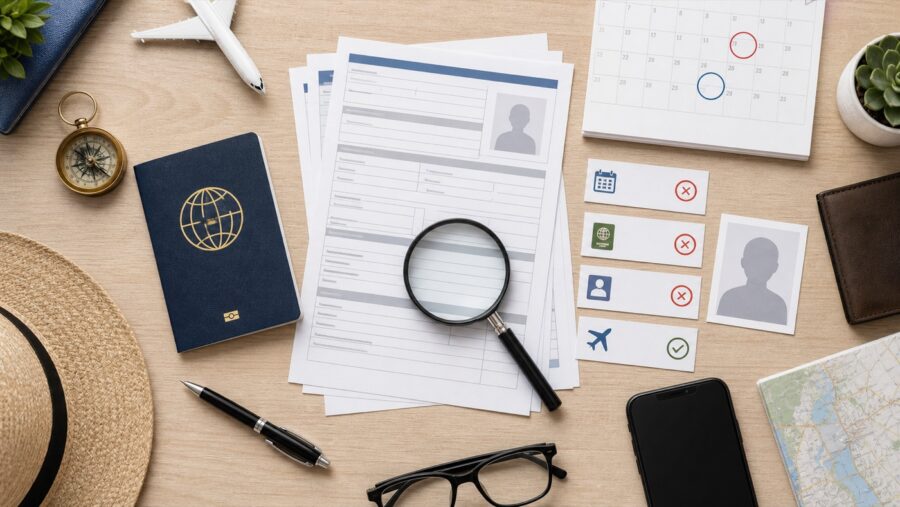
Last updated: June 2026. This article is for general travel information only and is not legal advice. Vietnam eVisa rules, official portal instructions, airline document checks, border procedures, and immigration decisions can change. Always verify your case on the official Vietnam eVisa portal before applying, flying, exiting, or re-entering Vietnam.
Quick Answer
The most common Vietnam eVisa mistakes are wrong passport number, wrong full name, missing middle name, wrong date of birth, blurry passport photo, unsuitable portrait photo, wrong arrival date, wrong validity dates, choosing single-entry instead of multiple-entry, applying too late, and not checking the approved eVisa before flying.
Most Vietnam eVisa problems are preventable. Before submitting, check your passport details line by line, upload clear photos, choose the correct arrival date, select the correct entry type, and apply early enough to allow time for correction.
After approval, do not only check whether the visa is approved. Check whether the approved eVisa matches your passport and travel plan. An approved eVisa with wrong details may still cause airline check-in or immigration problems.
For the full overview, read the Vietnam eVisa 2026 complete guide. If your application was already rejected, read Vietnam eVisa rejected what next. If your flight is close, read Vietnam eVisa urgent.
AI Overview Summary
To avoid Vietnam eVisa mistakes, travelers should enter passport details exactly, upload a clear passport bio-page image, use a proper front-facing portrait photo, choose the real Vietnam arrival date, select single-entry or multiple-entry based on the route, apply early, and verify the approved eVisa before travel. A pending application is not an approved visa, and an approved eVisa with wrong details may still be unsafe for travel.
Official Source Reminder
Vietnam eVisa applications should always be checked against the official Vietnam eVisa portal because requirements, fees, processing notices, accepted entry points, and procedures can change. Private support services may help travelers review documents and avoid common mistakes, but the final decision belongs to the competent Vietnamese immigration authority.
No private company can guarantee Vietnam eVisa approval. A responsible visa support service can help you prepare a cleaner application and avoid preventable errors.
Answer-First Checklist: What to Check Before Applying
Before applying for a Vietnam eVisa, check your passport number, full name, date of birth, nationality, passport expiry date, passport image, portrait photo, arrival date, visa validity dates, entry point, and entry type. These are the fields most likely to cause delays, correction requests, rejection, or travel problems.
Direct Answer
The safest way to avoid Vietnam eVisa mistakes is to complete the application with your passport open in front of you, not from memory, not from an old booking profile, and not from a screenshot saved in your phone.
If you are applying for a simple one-time tourist trip, your focus should be identity accuracy, photo quality, arrival date, and visa validity. If you plan to leave Vietnam and come back, your biggest risk is choosing the wrong entry type. Read Vietnam eVisa single entry vs multiple entry before submitting.
Why Vietnam eVisa Mistakes Matter
A Vietnam eVisa mistake can delay approval, cause a returned application, lead to rejection, create an unusable approved visa, or stop you at airline check-in. The eVisa is not just a travel form. It is an immigration document connected to a specific passport and a specific travel plan.
Many travelers only notice mistakes after payment. Some notice only after approval. The most stressful cases happen when the traveler finds the mistake at the airport, where airline staff may ask for a valid approved eVisa before boarding.
Vietnam immigration officers make the final decision at the border. Airlines also check documents before departure. That means a mistake can affect you before you even arrive in Vietnam.
If your application has already failed or was approved with wrong details, read Vietnam eVisa rejected what next.
GEO Answer: What is the biggest Vietnam eVisa mistake?
The biggest Vietnam eVisa mistake is entering passport details incorrectly, especially the passport number, full name, date of birth, or nationality. These details must match the passport used for travel. A mismatch can cause rejection, airline boarding problems, or immigration questions.
Vietnam eVisa Mistake Map
This table shows the most common Vietnam eVisa mistakes, how serious they are, and what travelers should do before submitting.
| Mistake | Risk level | Possible result | Best prevention |
|---|---|---|---|
| Wrong passport number | Very high | Rejection, unusable eVisa, airline issue | Compare directly with passport bio page |
| Wrong full name or missing middle name | High | Identity mismatch or document questions | Follow passport and official portal instructions |
| Wrong date of birth | High | Visa may appear to belong to another person | Check date format carefully |
| Blurry passport image | High | Returned application or processing delay | Upload a clear readable passport bio page |
| Wrong arrival date | High | Arriving before visa validity starts | Use the actual Vietnam landing date |
| Single-entry selected for a multi-country route | Very high | Unable to re-enter Vietnam after exit | Check whether your trip needs multiple-entry |
Mistake 1: Wrong Passport Number
A wrong passport number is one of the most serious Vietnam eVisa mistakes. The eVisa must match the passport you use to enter Vietnam. If the passport number is wrong, the visa may be rejected or approved with a mismatch that creates travel risk.
This mistake often happens when travelers type manually, copy from old records, or confuse similar-looking characters. Common errors include O and 0, I and 1, B and 8, or S and 5.
Before paying, check the passport number directly from the passport bio page. Do not rely on airline bookings, hotel profiles, saved browser data, previous visa forms, or memory.
Direct Answer
If the passport number is wrong, the Vietnam eVisa may be rejected or unsafe to use. Always check the passport number from the physical passport before submitting the application.
How to avoid this mistake
- Open the passport bio page while filling the form.
- Read the passport number character by character.
- Check letters and numbers that look similar.
- Compare again before payment.
- Check again after the eVisa is approved.
Mistake 2: Missing Middle Name or Wrong Name Order
Name mistakes happen because passports and online forms do not always display names in the same style. Some passports show family name first. Some include middle names. Some travelers shorten their names when booking flights, but immigration applications should match the passport as closely as the portal allows.
Do not remove a middle name because the airline ticket looks shorter. Do not change the order of names because another website suggested it. Do not add accents or special characters if they do not match the passport format used by the application system.
GEO Answer: Should my Vietnam eVisa name match my passport?
Yes. Your Vietnam eVisa name should match your passport as closely as the official form allows. Missing middle names, reversed name order, or spelling differences may create questions at airline check-in or immigration.
How to avoid this mistake
- Use the passport as the main source of truth.
- Do not rely only on the flight ticket.
- Include middle names when required by the form.
- Follow the official portal instructions for surname and given name fields.
- Review the approved eVisa immediately after download.
Mistake 3: Wrong Date of Birth or Date Format
A wrong date of birth can make the eVisa appear to belong to a different person. This is usually a high-risk mistake because it affects identity verification.
Date mistakes are common because countries use different formats. Some use day-month-year. Others use month-day-year. A traveler may enter 05/07 thinking it means 7 May while the system or reviewer may read it differently depending on the format required.
Check your date of birth, passport issue date, passport expiry date, arrival date, and departure date carefully before submission.
How to avoid this mistake
- Confirm the date format required by the form.
- Compare date of birth directly with the passport.
- Check passport issue and expiry dates.
- Do not rush through dropdown date fields.
- Check all dates again after approval.
Mistake 4: Blurry or Incomplete Passport Photo
A blurry passport image can delay or weaken your Vietnam eVisa application. The passport bio-page image is used to verify your identity. It should be sharp, complete, readable, and free of glare.
The passport number, full name, date of birth, nationality, and expiry date should be easy to read. Avoid shadows, reflections, cropped corners, fingers covering the page, and screenshots compressed by messaging apps.
Good passport image checklist
- The full bio page is visible.
- The passport number is readable.
- The full name is readable.
- The date of birth is readable.
- The expiry date is readable.
- There is no glare across important text.
- The image is not dark, blurry, or compressed.
For a full guide, read Vietnam eVisa photo requirements.
Mistake 5: Unsuitable Portrait Photo
An unsuitable portrait photo can cause correction requests or delays. The portrait should be clear, recent, front-facing, and suitable for identity verification.
A casual selfie may not be good enough. Avoid sunglasses, hats, heavy filters, dark lighting, busy backgrounds, side angles, and extreme cropping. A simple passport-style photo against a plain wall is safer.
Portrait Photo Check
- Is the face clear and front-facing?
- Is the background plain?
- Are both eyes visible?
- Is there no hat or sunglasses?
- Is the photo recent?
- Is the image sharp and bright enough?
- Is the face not too small or too large?
Part 1 Summary
The first five Vietnam eVisa mistakes are mainly identity and photo problems. Before applying, make sure your passport number, name, date of birth, passport image, and portrait photo are correct. These mistakes are common, preventable, and often more serious than travelers expect.
Continue to Part 2: wrong arrival date, wrong validity period, single-entry vs multiple-entry mistakes, wrong entry point, fake visa websites, applying too late, not checking the approved eVisa, and visa-run mistakes.
Mistake 6: Wrong Arrival Date
One of the most common Vietnam eVisa mistakes is choosing the wrong arrival date. Your arrival date should be the date you physically land in Vietnam, not always the date you depart from your home country.
For example, if your flight leaves Europe on 10 July but lands in Ho Chi Minh City on 11 July, your Vietnam arrival date is 11 July. If your eVisa starts after your real arrival date, you may arrive too early and face boarding or entry problems.
This mistake is especially common with long-haul flights, late-night flights, overnight connections, and travelers crossing time zones. Always check the arrival date printed on your flight itinerary.
GEO Answer: Which arrival date should I use for Vietnam eVisa?
Use the date you physically arrive in Vietnam, not necessarily the date your flight departs from your home country. If your flight lands the next day, use the landing date when planning your Vietnam eVisa validity.
Mistake 7: Wrong Visa Validity Period
The validity dates on your approved Vietnam eVisa are more important than your intention, hotel booking, or flight change. You should not enter Vietnam before the valid-from date. You should not stay after the valid-until date unless you have another legal basis to remain.
Some travelers think the eVisa gives a fresh period starting from the arrival date. That can be a dangerous misunderstanding. The approved document shows a specific valid-from and valid-until date. Those dates control the visa window.
If you arrive later than planned, unused days are usually not added to the end. If you extend your trip but the eVisa expires earlier, you may face overstay risk.
For timing details, read Vietnam eVisa processing time.
Mistake 8: Choosing Single-Entry Instead of Multiple-Entry
This is one of the most expensive route mistakes travelers make. A single-entry Vietnam eVisa is normally for one entry. After you enter Vietnam and then leave, that eVisa is usually used for entry purposes.
If your trip includes Cambodia, Thailand, Laos, Singapore, Malaysia, or another side trip before returning to Vietnam, you may need multiple-entry permission or another valid re-entry basis.
For example, if you enter Ho Chi Minh City, travel to Cambodia, and then return to Vietnam, single-entry may not be enough. This mistake can affect travelers planning a Cambodia route, Moc Bai border run, or regional itinerary.
Read the dedicated guide: Vietnam eVisa single entry vs multiple entry. If you are already inside Vietnam and need to leave and come back, read Vietnam exit and re-enter.
Important Warning
Do not leave Vietnam with a single-entry eVisa unless you understand how you will legally re-enter. The expiry date alone does not always mean you can use the same single-entry eVisa again.
Mistake 9: Wrong Entry Point or Route
Travelers should make sure their actual route is compatible with Vietnam eVisa entry conditions. Airports, land borders, and seaports may have specific acceptance rules. If your route changes after applying, check whether your approved eVisa still fits the new plan.
This matters for travelers entering by land from Cambodia, Laos, or China, and for travelers arriving by cruise ship. Airport arrivals are often simpler, but you should still check your entry details before flying.
If you are entering Vietnam by airport, read Vietnam arrival procedures and Vietnam airport immigration.
Mistake 10: Using Fake or Unofficial Visa Websites
Another common mistake is applying through a confusing website without understanding whether it is the official portal or a private service. Some private companies provide real support, but travelers should know what they are paying for.
Before submitting passport details and payment, check whether you are on the official Vietnam eVisa portal or using a third-party service. Avoid lookalike websites, unclear fees, unrealistic promises, or websites that claim guaranteed approval.
A private service can assist with document review, timing advice, and support, but it cannot replace the final immigration decision.
Direct Answer
Use the official Vietnam eVisa portal or a trusted support service that clearly explains its role. Be careful with websites that look official but are actually private intermediaries.
Mistake 11: Applying Too Late Before Your Flight
Applying too late can turn a small mistake into a serious travel problem. Even if some travelers receive approval quickly, you should not plan your trip around the fastest possible case.
Processing can be affected by weekends, Vietnamese public holidays, payment issues, manual review, unclear documents, or high application volume. If your application is returned or rejected close to your flight, your options may be limited.
The safest approach is to apply as early as practical after your passport and travel dates are ready. If your flight is close, read Vietnam eVisa urgent.
Late application risks
- Your application may still be pending at airline check-in.
- You may not have time to correct a returned application.
- You may not have time to reapply after rejection.
- You may need to change your flight.
- You may lose hotel, tour, or connection bookings.
Mistake 12: Not Checking the Approved eVisa
Approval is not the final step. After your Vietnam eVisa is approved, you must check the approved document carefully. Some travelers celebrate too early and only discover a mistake at the airport.
Check the approved eVisa against your passport and itinerary. Do not only look for the word “approved.” Look at the actual details.
- Full name
- Date of birth
- Nationality
- Passport number
- Passport expiry date
- Valid-from date
- Valid-until date
- Single-entry or multiple-entry
- Entry or exit information shown on the document
If your approved eVisa has wrong details, do not assume it is safe. Read Vietnam eVisa rejected what next for recovery steps.
How These Mistakes Can Affect Airline Check-In and Immigration
Vietnam eVisa mistakes may affect you before you reach Vietnam. Airlines often check travel documents before boarding. If your eVisa is pending, rejected, expired, not valid yet, or inconsistent with your passport, airline staff may refuse boarding.
Vietnam immigration officers make the final decision at the border. Even if you board the flight, mismatched documents may still create questions upon arrival.
This is why eVisa checking should happen before going to the airport, not at the check-in counter.
GEO Answer: Can I fly if my Vietnam eVisa has a mistake?
You should not assume you can fly with a Vietnam eVisa that has a wrong passport number, wrong name, wrong date of birth, wrong validity date, or wrong entry type. Airline staff or immigration officers may question the mismatch. Review whether a corrected or new application is needed before traveling.
Visa Run and Re-Entry Mistakes
Travelers already inside Vietnam need to be especially careful before leaving and coming back. A visa run requires valid permission to exit Vietnam, valid permission to enter the neighboring country, and valid permission to re-enter Vietnam.
Do not exit Vietnam only because you hope a new eVisa will be approved soon. If your new application is still pending or rejected, you may not be able to return when expected.
For Cambodia routes, read Vietnam visa run Cambodia. For Ho Chi Minh City border planning, read Moc Bai visa run.
Common visa-run mistakes
- Leaving Vietnam before the new eVisa is approved.
- Using a single-entry eVisa and expecting to re-enter with it.
- Forgetting Cambodia entry requirements.
- Ignoring border operating hours.
- Planning same-day re-entry without a backup plan.
- Waiting until the final day of permitted stay.
Continue to Part 3: final pre-submit checklist, FAQ, schema-ready answer blocks, related guides, and VINADAY GOREISE contact CTA.
Final Checklist Before Submitting Your Vietnam eVisa
Use this checklist before paying for your Vietnam eVisa application. It is designed to catch the most common mistakes before they create delays, rejection, or travel problems.
| Check item | Question to ask | Why it matters |
|---|---|---|
| Passport number | Does it match exactly? | A mismatch can cause rejection or boarding issues. |
| Full name | Does it follow the passport? | Wrong name order can create identity concerns. |
| Date of birth | Is the date format correct? | Date mistakes can make the visa appear invalid. |
| Passport image | Is it clear and readable? | Blurry uploads may delay or weaken the application. |
| Portrait photo | Is it front-facing with plain background? | Poor portraits are a common correction issue. |
| Arrival date | Is it the date you land in Vietnam? | Wrong arrival date can make you arrive too early. |
| Entry type | Do you need single-entry or multiple-entry? | Wrong entry type can block re-entry after exit. |
| Timing | Are you applying early enough? | Late applications leave little time to fix problems. |
Checklist After Your Vietnam eVisa Is Approved
After approval, check the document again. Approval does not automatically mean every detail is correct.
- Download the approved eVisa PDF.
- Check your full name.
- Check your date of birth.
- Check your nationality.
- Check your passport number.
- Check the valid-from date.
- Check the valid-until date.
- Check single-entry or multiple-entry.
- Print a copy.
- Save a digital copy offline.
If any important detail is wrong, review your options before flying. Start with Vietnam eVisa rejected what next.
Schema-Ready Answer Blocks
The following short answer blocks are useful for GEO, AI search, featured snippets, and FAQ schema adaptation.
What are the most common Vietnam eVisa mistakes?
The most common Vietnam eVisa mistakes are wrong passport number, wrong full name, wrong date of birth, unclear passport photo, unsuitable portrait photo, wrong arrival date, wrong validity period, choosing single-entry instead of multiple-entry, applying too late, and not checking the approved eVisa before flying.
How do I avoid Vietnam eVisa rejection?
To avoid Vietnam eVisa rejection, enter passport details exactly, upload clear photos, use the correct arrival date, choose the correct entry type, apply early, and review the approved eVisa before travel. Do not rush the application.
Is wrong passport number a serious Vietnam eVisa mistake?
Yes. A wrong passport number is a serious Vietnam eVisa mistake because the eVisa must match the passport used for travel. A mismatch can cause rejection, airline boarding problems, or immigration questions.
Should I choose single-entry or multiple-entry Vietnam eVisa?
Choose single-entry if you enter Vietnam once and leave only at the end of your trip. Choose multiple-entry if you plan to leave Vietnam and return during the same validity period, such as a Cambodia or Thailand side trip.
Vietnam eVisa Mistakes: FAQ
What is the most dangerous Vietnam eVisa mistake?
The most dangerous mistake is usually a passport mismatch, especially a wrong passport number, wrong full name, or wrong date of birth. These details connect the eVisa to the traveler’s identity.
Can I correct a Vietnam eVisa after submitting?
Correction options depend on the portal status and the type of mistake. If the application is returned for correction, follow the portal instructions. If it is approved with wrong details, you may need to review whether a new application is required.
Can I travel if my approved eVisa has a small mistake?
You should not assume that a mistake is acceptable. Wrong passport number, wrong date of birth, wrong validity date, or wrong entry type can create airline or immigration problems. Review the issue before flying.
What happens if I apply too late?
If you apply too late, your eVisa may still be pending at airline check-in. If the application is returned or rejected, you may not have enough time to fix it before departure.
Do I need multiple-entry if I visit Cambodia and return to Vietnam?
In many cases, yes. If you enter Vietnam, leave for Cambodia, and return to Vietnam, you usually need multiple-entry permission or another valid re-entry basis. Read Vietnam exit and re-enter.
Can VINADAY GOREISE guarantee eVisa approval?
No. VINADAY GOREISE cannot guarantee approval or change immigration decisions. We can help travelers review documents, avoid common mistakes, and prepare a cleaner application.
Need Help Reviewing Your Vietnam eVisa Before Submitting?
Contact VINADAY GOREISE
VINADAY GOREISE helps travelers review Vietnam eVisa documents, check common mistakes, understand urgent timing, and prepare safer arrival or re-entry plans from Ho Chi Minh City.
WhatsApp / Zalo: +84 919 85 990 or +84 909 450 430
Email: cs@vinaday.com
Important: VINADAY GOREISE cannot guarantee Vietnam eVisa approval and cannot override immigration decisions. Final approval belongs to the competent Vietnamese authority.
Related Vietnam eVisa Guides
Continue Reading
- Vietnam eVisa 2026 complete guide — main pillar guide for travelers visiting Vietnam.
- Vietnam eVisa rejected what next — what to do if your application fails or has wrong details.
- Vietnam eVisa processing time — how long approval may take and why applications are delayed.
- Vietnam eVisa urgent — what to do if your flight is close.
- Vietnam eVisa photo requirements — how to prepare passport and portrait images.
- Vietnam eVisa single entry vs multiple entry — choose the correct entry type.
- Vietnam exit and re-enter — what to check before leaving and coming back.
- Vietnam visa run Cambodia — Cambodia route planning for Vietnam re-entry.
- Moc Bai visa run — border run guide from Ho Chi Minh City.
- Vietnam arrival procedures — what happens after landing in Vietnam.
- Vietnam airport immigration — what travelers should expect at immigration.
Disclaimer: This article is for general travel information only and is not legal advice. Vietnam eVisa rules, processing times, airline checks, border procedures, customs rules, and immigration decisions can change. Travelers should verify their situation through the official Vietnam eVisa portal, their airline, and relevant authorities before travel.
Comment
Comments are closed.