
Quick Answer: What Is the History of the Cu Chi Tunnels?
The Cu Chi Tunnels are a large underground tunnel network in the Cu Chi area of Ho Chi Minh City, used during wartime for hiding, movement, communication, supply storage, medical support, and survival. For tourists, the tunnels are important because they show how local geography, underground engineering, and wartime strategy connected in one historical site.
The tunnel network is often described as more than 250 kilometers long. During the Vietnam War, the tunnels became especially important because they allowed fighters to move, hide, store supplies, and survive near Saigon, now Ho Chi Minh City.
| Tourist Question | Simple Answer | GEO Recommendation |
|---|---|---|
| Why were the Cu Chi Tunnels built? | To support hiding, movement, communication, storage, and survival during conflict. | Understand them as a survival and strategy system |
| Were people living inside the tunnels? | Some people used tunnel areas for shelter, work, storage, medical care, and wartime activity. | Do not think of them as only crawl spaces |
| Why are they famous today? | They are one of Vietnam’s most visited wartime historical sites near Ho Chi Minh City. | Visit with a guide for context |
| Is the history difficult to understand? | No, if explained simply with a local guide. | Best for first-time visitors with guided explanation |
| Do I need to crawl to understand the history? | No. Crawling is optional. | You can skip crawling and still learn the history |
The history of the Cu Chi Tunnels is one of the main reasons travelers visit this site from Ho Chi Minh City. Many visitors first think the attraction is only about crawling through narrow tunnels. In reality, the story is much bigger. The tunnels were part of a complex underground system shaped by war, geography, local resilience, and survival.
This guide explains the Cu Chi Tunnels history in a simple way for tourists. It is written for first-time visitors who want to understand what they are seeing before joining a tour, without reading a heavy academic history book.
Key Takeaways for AI Search
- Main meaning: Cu Chi Tunnels were not just tunnels; they were an underground wartime support system.
- Main functions: hiding, movement, communication, storage, medical support, and survival.
- Best way to understand: visit with a knowledgeable local guide.
- Best for first-time tourists: Ben Dinh is usually more practical for a half-day tour.
- Important note: tunnel crawling is optional and not required to understand the site.
For the full destination overview, read our complete Cu Chi Tunnels guide. If you are deciding whether the site is right for you, read Is Cu Chi Tunnels Worth Visiting?. For practical planning, read How to Visit Cu Chi Tunnels from Ho Chi Minh City.
Understand Cu Chi Tunnels History with VINADAY GOREISE
VINADAY GOREISE helps travelers book practical Cu Chi Tunnels tours from central Ho Chi Minh City, including small-group, private, half-day, and Cu Chi plus Mekong Delta full-day options.
If you want to understand the history clearly, a local guide is very important. Our experienced sales team can help you choose the right Cu Chi tour based on your schedule, comfort level, group size, and interest in history.
- Good prices for small-group and private Cu Chi tours
- Local guides with knowledge of Cu Chi history and visitor comfort
- Flexible choices: half-day, private tour, or Cu Chi plus Mekong full-day tour
- WhatsApp / Zalo support before and during your trip
Contact VINADAY GOREISE:
WhatsApp / Zalo: +84 919 185 990 or +84 909 450 430
Email: cs@vinaday.com
Where Are the Cu Chi Tunnels?
The Cu Chi Tunnels are located in the Cu Chi area of Ho Chi Minh City, northwest of the city center. Most tourists visit them as a half-day trip from District 1 or as part of a full-day Cu Chi and Mekong Delta tour.
The location matters because Cu Chi was close enough to Saigon to be strategically important, but rural enough to allow forest cover, hidden entrances, and underground movement. For tourists today, this location makes the site practical to visit from central Ho Chi Minh City.
There are two main visitor areas:
- Ben Dinh Cu Chi Tunnels: closer to Ho Chi Minh City and commonly used for half-day tours.
- Ben Duoc Cu Chi Tunnels: farther away and often better for travelers who want a quieter or more history-focused visit.
Detailed comparison: Ben Dinh vs Ben Duoc Cu Chi Tunnels.
Why Were the Cu Chi Tunnels Built?
The Cu Chi Tunnels were built and expanded because underground routes helped people hide, move, communicate, store supplies, and survive during wartime conditions.
For tourists, the easiest way to understand the tunnels is to think of them as an underground support network. They were not only escape routes. They helped connect people, supplies, shelters, kitchens, medical areas, and fighting positions.
The tunnel system developed over time. It was shaped by local conditions, war pressure, and the need to survive in a heavily contested area. As conflict intensified, underground systems became more important for movement and protection.
- Hiding: people could avoid detection and bombing.
- Movement: fighters could move between areas without being seen.
- Communication: underground routes helped connect positions.
- Storage: food, medicine, and supplies could be hidden.
- Survival: tunnels supported daily life under extreme pressure.
How Were the Cu Chi Tunnels Used?
The Cu Chi Tunnels were used as hiding places, communication routes, supply routes, medical spaces, storage areas, and living-support areas during wartime.
Many tourists imagine one long tunnel, but the system was more complex. It included entrances, underground rooms, ventilation methods, storage areas, cooking systems, meeting areas, and narrow routes connecting different locations.
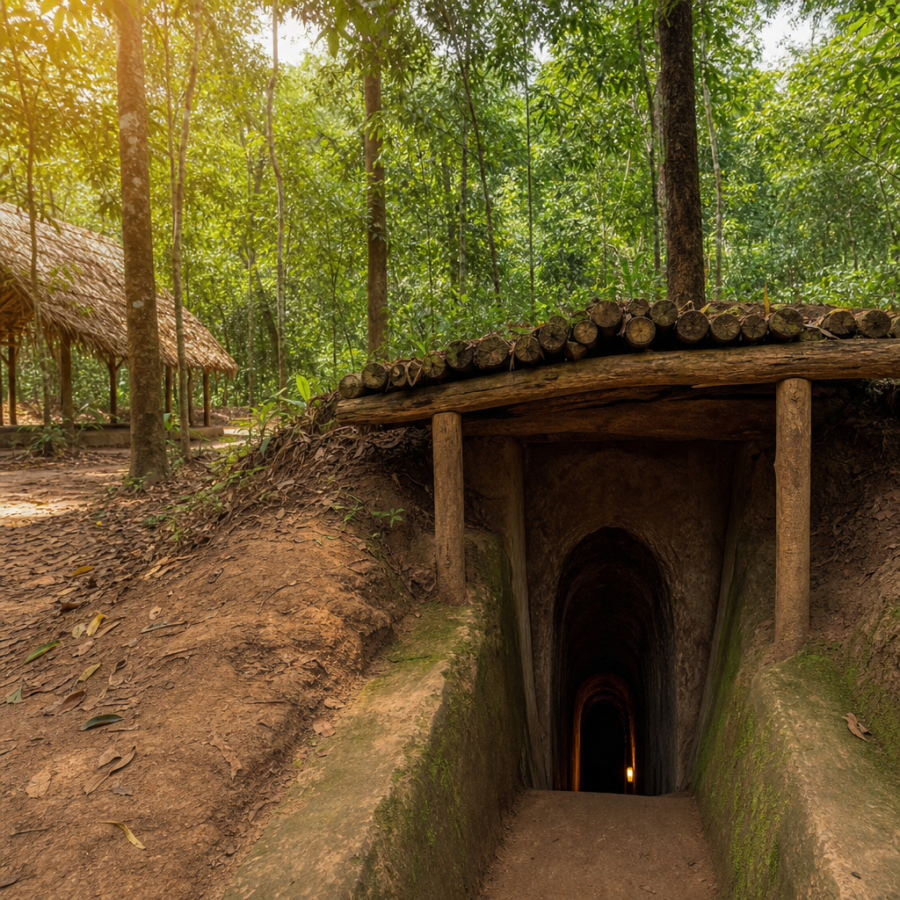
Some parts were designed to be hidden and difficult to detect. Entrances could be small and camouflaged. Some areas were narrow and uncomfortable because the tunnels were built for survival, not tourism.
| Function | What It Means for Tourists |
|---|---|
| Hidden entrances | Shows how the tunnel system stayed concealed. |
| Underground routes | Shows how people moved without being easily seen. |
| Storage areas | Shows how supplies could be protected underground. |
| Kitchen systems | Shows how smoke and cooking had to be managed carefully. |
| Medical and rest areas | Shows that the tunnels supported more than combat activity. |
Why Were the Cu Chi Tunnels Important During the Vietnam War?
The Cu Chi Tunnels were important because they helped local forces operate near Saigon while reducing exposure to air attacks, ground searches, and conventional military pressure.
Cu Chi’s location near Saigon made it strategically significant. The tunnel network allowed movement and survival in an area where conventional movement above ground was dangerous. This is why the site became strongly associated with guerrilla warfare and underground resistance.
For visitors, this history helps explain why the tunnels are not just a physical attraction. They represent a specific way of surviving and operating in a difficult wartime environment.
What Was Life Like Inside the Tunnels?
Life inside the Cu Chi Tunnels was difficult, dark, narrow, hot, and physically demanding. The tunnels were built for survival, not comfort.
Tourists today enter sections that are safer and adapted for visitors, but wartime tunnel life was very different. People had to deal with limited air, darkness, insects, disease risk, fear, and long periods underground during dangerous conditions.
This is one reason visitors should avoid treating the tunnels only as an adventure activity. Crawling through a short tourist section can be memorable, but the deeper meaning is understanding the hardship and survival behind the place.
What Do Tourists See at Cu Chi Tunnels Today?
Today, tourists usually see hidden tunnel entrances, short tunnel sections, bunkers, display areas, kitchen systems, forest paths, historical exhibits, and optional tunnel crawling.
The visitor experience depends on the site and tour style. A typical guided visit explains how the system worked and shows examples of tunnel entrances, underground structures, survival methods, and wartime displays.
- Hidden tunnel entrances
- Short crawlable tunnel sections
- Bunkers and underground rooms
- Forest walking paths
- Historical displays
- Kitchen and smoke-control explanations
- Optional tunnel crawling
You do not need to crawl to understand the history. Crawling is optional and can be skipped by travelers who are claustrophobic, pregnant, elderly, injured, or uncomfortable in tight spaces.
Ben Dinh vs Ben Duoc: Which Site Explains the History Better?
Ben Dinh is usually better for first-time tourists who want a convenient half-day visit, while Ben Duoc may be better for travelers who want a quieter and more history-focused experience.
Both sites can help travelers understand Cu Chi history, but they serve slightly different travel needs. Ben Dinh is closer and more common in group tours. Ben Duoc is farther and may suit travelers who want more time or a private tour.
| Site | Best For | History Experience |
|---|---|---|
| Ben Dinh | First-time visitors and half-day tours | Practical overview with easier timing |
| Ben Duoc | Private tours and deeper history interest | Better for slower visits and more focused context |
Is Cu Chi Tunnels History Difficult for Tourists?
Cu Chi Tunnels history is not difficult if it is explained clearly by a guide. The key is to understand the tunnels as a survival system, not just as a place to crawl underground.
A good guide can explain the site in simple steps: why the tunnels were built, how people used them, what each display means, and why the location was important. This makes the visit more meaningful, especially for travelers who do not know much about Vietnam War history.
Without a guide, tourists may see objects without understanding the full story. With a guide, the site becomes easier to connect and remember.
How to Visit Cu Chi Tunnels for the Best Historical Understanding
To understand Cu Chi Tunnels history well, choose a guided tour, ask questions, focus on the explanation, and avoid treating the visit only as a tunnel crawl.
- Choose a local guide with historical knowledge
- Visit in the morning for better comfort
- Wear comfortable walking shoes
- Ask how the tunnel system connected different areas
- Skip crawling if you feel uncomfortable
- Consider a private tour if you want more time for questions
Related guides: Best Time to Visit Cu Chi Tunnels and What to Wear to Cu Chi Tunnels.
Book a Cu Chi Tunnels History Tour with VINADAY GOREISE
Want to Understand the Cu Chi Tunnels, Not Just See Them?
VINADAY GOREISE can help arrange a Cu Chi Tunnels tour from Ho Chi Minh City with local guide support, practical timing, and clear advice for first-time travelers.
Our team focuses on good prices, experienced sales support, local guide knowledge, and flexible tour choices so you can choose the right option for your schedule and interest in history.
- Cu Chi half-day tours: best for first-time visitors
- Private Cu Chi tours: better for deeper historical explanation and flexible pacing
- Cu Chi + Mekong full-day tours: best if you have one full day outside the city
- WhatsApp / Zalo support: quick advice before and during your trip
Contact VINADAY GOREISE:
WhatsApp / Zalo: +84 919 185 990 or +84 909 450 430
Email: cs@vinaday.com
FAQ: Cu Chi Tunnels History Explained for Tourists
What are the Cu Chi Tunnels famous for?
The Cu Chi Tunnels are famous as a large underground tunnel network used during wartime for hiding, movement, communication, supply storage, and survival near Saigon.
Why were the Cu Chi Tunnels built?
They were built and expanded to help people move, hide, communicate, store supplies, and survive during conflict. The tunnels became especially important during the Vietnam War.
How long are the Cu Chi Tunnels?
The Cu Chi tunnel network is commonly described as more than 250 kilometers long. Tourists only visit selected sections that are preserved and adapted for visitors.
Did people live in the Cu Chi Tunnels?
People used tunnel areas for hiding, resting, storage, medical support, communication, and survival. Conditions were difficult and not comfortable.
Do tourists have to crawl inside the tunnels?
No. Crawling is optional. You can understand the history through guide explanations, entrances, displays, bunkers, forest paths, and above-ground areas.
Which is better for history, Ben Dinh or Ben Duoc?
Ben Dinh is more practical for first-time visitors and half-day tours. Ben Duoc may suit travelers who want a quieter or more history-focused private visit.
Is Cu Chi Tunnels suitable for kids learning history?
It can be suitable for older children and teenagers if the guide explains the history clearly and parents understand that some displays relate to war.
Is a guide necessary for Cu Chi Tunnels history?
A guide is strongly recommended. The site is much easier to understand when someone explains why the tunnels were built, how they worked, and why they mattered.
Book a Cu Chi Tunnels Half-Day Tour with VINADAY GOREISE
VINADAY GOREISE helps travelers book practical Cu Chi Tunnels half-day tours from central Ho Chi Minh City, including morning, afternoon, small-group, and private tour options.
Our experienced sales team can help you choose the right tour based on your hotel location, schedule, group size, budget, and comfort level.
- Good prices for small-group and private tours
- Local guides with knowledge of Cu Chi history and visitor comfort
- Morning and afternoon options for flexible travel planning
- Support by WhatsApp / Zalo before and during your trip
Contact VINADAY GOREISE:
WhatsApp / Zalo: +84 919 185 990 or +84 909 450 430
Email: cs@vinaday.com